
ECOMMERCE SOFTWARE · BUYING GUIDE · 2027
Best Help Desk Software for Ecommerce in 2027
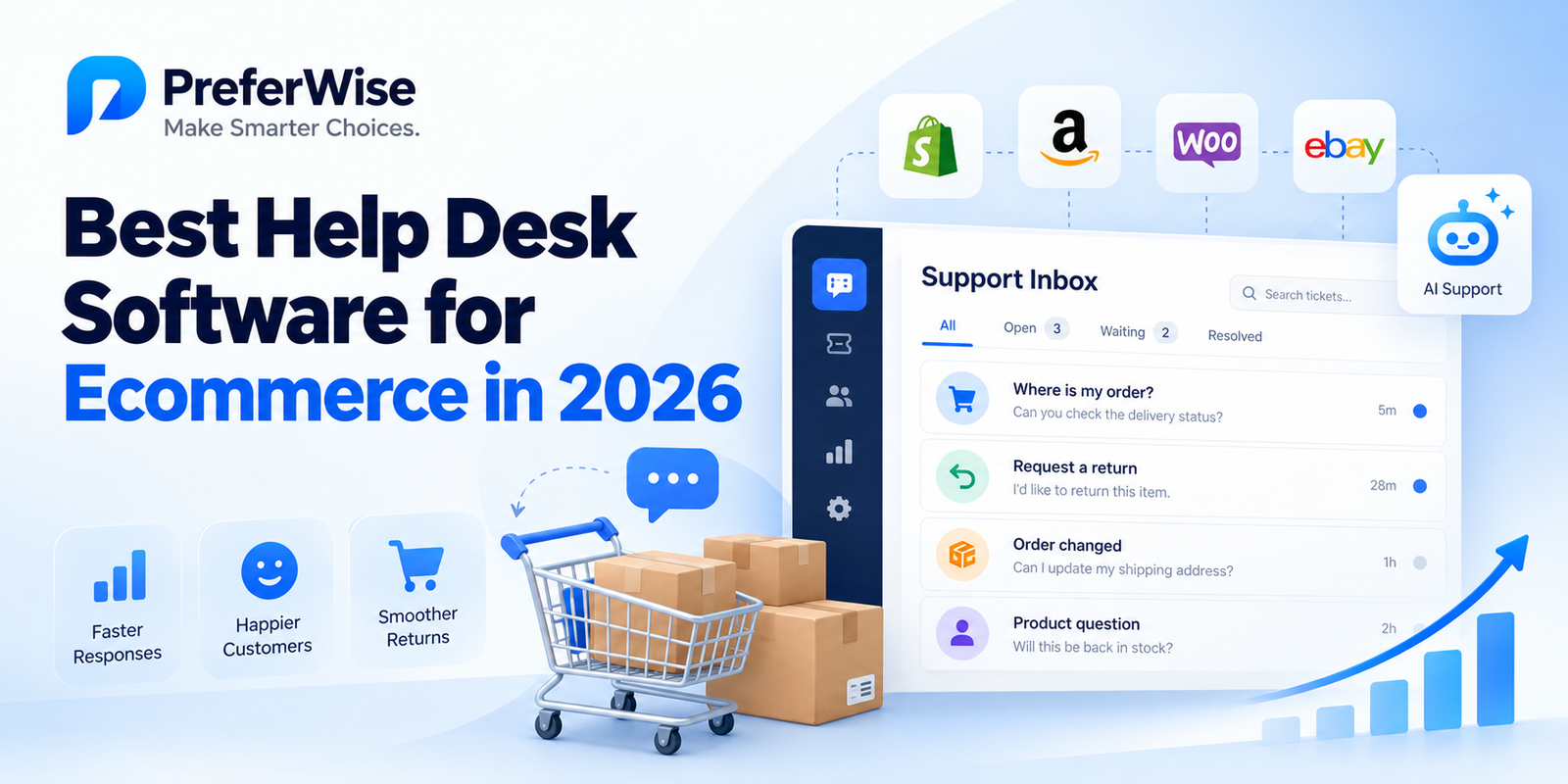
The right help desk helps online stores answer order questions, manage returns, connect customer conversations to purchases and handle busy sales periods. Compare eight tools by integrations, support workflows, pricing models and the type of ecommerce business each suits.
Prices, integrations and plan limits can change. Verify current terms directly with each vendor before purchasing.
Best ecommerce help desk software: quick picks
These are use-case-based shortlists, not a universal ranking. Choose based on your store platform, support channels, workload and budget.
Gorgias
Consider it for ecommerce-centric support workflows and order context.
Official pricing ↗Tidio
Evaluate it for website chat, automated flows and AI-assisted service.
Official pricing ↗Freshdesk
A general-purpose ticketing platform to consider for growing support teams.
Official pricing ↗Zendesk
Evaluate its routing, reporting, permissions and broader support workflows.
Official pricing ↗Zoho Desk
Consider it if your business uses Zoho or needs a general help desk with ecommerce extensions.
Official pricing ↗Help Scout
Evaluate its shared inbox and collaboration workflows for email-led support.
Official pricing ↗Re:amaze
A candidate for stores bringing email, chat and social conversations together.
Official pricing ↗eDesk
Worth evaluating for businesses managing customer service across multiple marketplaces and storefronts.
Official pricing ↗Compare the best ecommerce help desk software
The table compares each tool’s potential fit and the pricing details to investigate. The order is an editorial shortlist, not a measured performance ranking.
| Software | Best fit to investigate | Pricing model | What to verify | Official source |
|---|---|---|---|---|
| Gorgias | Shopify-focused brands | Ticket volume and applicable AI charges | Billable tickets, AI fees, channel integrations | Pricing ↗ |
| Tidio | Chat and AI-assisted support | Plan, conversation allowances and AI usage | Chat quotas, AI allowance, flow limits | Pricing ↗ |
| Freshdesk | General ticketing and support operations | Per agent plus applicable extras | Required tier, AI allowance, store integrations | Pricing ↗ |
| Zendesk | Complex support workflows | Per agent plus applicable add-ons | Required suite, AI features, channels, integrations | Pricing ↗ |
| Zoho Desk | Zoho users and budget-conscious teams | Free and paid per-user editions | Store extensions, data access, required plan | Pricing ↗ |
| Help Scout | Email-first support teams | Plan and applicable AI usage | Inbox limits, integrations, AI resolution fees | Pricing ↗ |
| Re:amaze | Multichannel store support | Per-user or volume-based options | Current plan, conversation definition, integrations | Pricing ↗ |
| eDesk | Marketplace and multistore sellers | Per user plus AI outcomes | Included stores, channels, AI outcome charges | Pricing ↗ |
Pricing models are not directly equivalent. Check billing frequency, region, taxes, plan eligibility, usage allowances and required add-ons.
How to choose help desk software for ecommerce
- Store and marketplace integrations. Verify your actual storefronts and sales channels. A listed integration may require an app, paid plan or third-party service.
- Order context. Check whether agents can view order history, shipping status and customer information inside their workspace.
- Returns and refunds. Distinguish between viewing an order and actually processing a return, refund, cancellation or address change.
- Channel coverage. Confirm support for email, live chat, social messaging and marketplace conversations relevant to your business.
- AI and automation. Review what AI can answer or change, when it escalates to a human, and how usage is billed.
- Normal and peak costs. Model a typical month and a busy sales period. Ticket-based pricing and per-agent pricing behave differently as demand changes.
- Reporting and permissions. Check routing, assignment, auditability, team reporting and access controls against your operational needs.
Test “Where is my order?”, “Can I change my address?”, “How do I return this item?” and “My package arrived damaged.” Compare time to resolve, available order actions, escalation quality and the expected bill.
The 8 best ecommerce help desk tools reviewed
01 · SHOPIFY-FOCUSED STORES
Gorgias
Best for: Shopify-first brands that want ecommerce activity connected to support conversations.
Gorgias positions its product around ecommerce customer service, with a ticket-based model and AI Agent capabilities. It is worth evaluating when order context and ecommerce-specific workflows are central to your agents’ daily work.
What to check
- Which Shopify order actions your plan supports.
- How tickets are counted across channels.
- Whether AI resolution fees are additional to subscription costs.
- How pricing changes during high-volume sales periods.
Potential drawback: Ticket volume and AI usage can make costs rise. Model a peak month before committing.
02 · CHAT AND AI SUPPORT
Tidio
Best for: Stores wanting website chat, automation and AI-assisted service.
Tidio combines customer-service tools with chat and its Lyro AI Agent. It can be a candidate for businesses that want to combine human assistance with automation, but the cost depends on the features and allowances the store needs.
What to check
- Conversation quotas and the price of additional usage.
- AI allowance and the definition of a billable conversation.
- Automation-flow and visitor limits.
- Whether store data is available in the required support workflow.
Potential drawback: Multiple quotas can make cost forecasting less straightforward.
03 · GENERAL CUSTOMER SUPPORT
Freshdesk
Best for: Stores needing a general-purpose ticketing and support platform.
Freshdesk is worth considering when the business needs structured ticket management, reporting and automation. Check whether the standard Freshdesk product or a broader Freshdesk Omni offering better matches the channels your store uses.
What to check
- Whether order context requires an app or integration.
- The required plan for reporting, routing and automation.
- Included AI usage and extra session charges.
- Which support channels are included in the selected product.
Potential drawback: An ecommerce-specific workflow may require extra integration or configuration.
04 · COMPLEX SUPPORT OPERATIONS
Zendesk
Best for: Larger support operations needing detailed routing, reporting and permissions.
Zendesk offers different customer-service plans with different capabilities. Ecommerce buyers should define their required workflows first, then select the relevant plan rather than assuming the entry price includes every feature.
What to check
- Whether you need Support Team or a broader Suite plan.
- How store data and marketplace conversations will be connected.
- Which AI features are included or charged separately.
- Any required apps, add-ons or onboarding fees.
Potential drawback: More complex requirements can increase subscription and implementation costs.
05 · ZOHO ECOSYSTEM
Zoho Desk
Best for: Teams using Zoho or wanting a general help desk with ecommerce extensions.
Zoho documents Shopify and WooCommerce integrations. Its Shopify extension can create tickets for orders and surface customer and order information, subject to integration configuration and the relevant store permissions.
What to check
- Whether the Shopify or WooCommerce extension covers your workflows.
- Which order and customer fields are available.
- Whether required automation or AI features need a paid edition.
- Whether your existing Zoho tools provide additional value.
Potential drawback: Validate the integration with real store scenarios before migrating your support operation.
06 · EMAIL-FIRST SUPPORT
Help Scout
Best for: Teams prioritizing a shared inbox and straightforward customer conversations.
Help Scout is worth evaluating when email-led support and team collaboration are more important than extensive ecommerce-specific functionality. Confirm whether your order data can be surfaced through a suitable integration.
What to check
- How order details appear in the agent workflow.
- Which integrations are native versus third-party.
- AI Answers usage and resolution pricing.
- Inbox, user and reporting limits in your selected plan.
Potential drawback: Deep order actions or extensive marketplace management may require extra integrations.
07 · MULTICHANNEL STORE SUPPORT
Re:amaze
Best for: Online businesses combining email, live chat and social customer conversations.
Re:amaze offers user-based and volume-based pricing options, according to its published pricing and support documentation. It may suit stores that want multichannel support and flexibility in how they pay.
What to check
- Whether your store and messaging integrations are supported.
- Whether user-based or volume-based billing better fits your workload.
- What counts as an active conversation under volume-based pricing.
- Current plan inclusions, AI features and limits.
Potential drawback: Check whether the volume definition and plan features match your store’s support pattern.
08 · MARKETPLACE AND MULTISTORE SELLERS
eDesk
Best for: Ecommerce businesses managing support across multiple marketplaces and storefronts.
eDesk focuses on ecommerce support, with integrations for storefronts, marketplaces and related operations. Its support workspace is designed to centralize customer conversations and surface order and delivery context. It is particularly worth evaluating when a seller operates across channels such as Amazon, eBay and Shopify.
eDesk’s official pricing page lists Essential, Growth and Professional plans at $39, $89 and $119 per user/month respectively with annual billing. The displayed monthly-billing prices are higher. AI Agent outcomes are priced at $0.99 per outcome according to the vendor’s published pricing page.
What to check
- Whether your exact marketplaces, storefronts and regions are supported.
- How many stores or marketplaces your selected plan includes.
- What counts as a billable AI outcome and how peak usage affects costs.
- Whether any additional channel or voice charges apply.
Potential drawback: Its multichannel capabilities may be more than a single-store business needs. Compare the cost against the channels you actually use.
How much does ecommerce help desk software cost?
Total cost depends on agents, ticket volume, required integrations, channels and AI usage. Seasonal sales can increase support volume, so compare a typical month with your busiest expected month.
Per-agent pricing
The baseline grows with the number of paid agents. It can be easier to forecast when staffing is stable, but adding temporary agents during peak season can raise the bill.
Ticket- or conversation-based pricing
These models tie some costs to support activity. Confirm what counts as a billable ticket or conversation and whether AI-handled requests are counted separately.
AI outcome pricing
AI may reduce repetitive agent work, but compare the fee against actual successful resolutions, escalation rates and the subscription cost. Do not assume that an attempted AI response and a resolved customer issue are billed in the same way across vendors.
For a detailed breakdown of billing models and hidden costs, read our help desk software total-cost comparison. You can also explore our Freshdesk pricing, Zendesk pricing, Zoho Desk pricing and Intercom pricing guides.
Which help desk is best for your ecommerce business?
Shopify-first brand
Evaluate Gorgias and compare order context, return workflows, channels and ticket/AI costs.
Small online store
Compare Freshdesk, Zoho Desk and Tidio. Avoid paying for advanced workflows you will not use.
Growing support team
Compare Zendesk and other scalable platforms on reporting, routing, permissions and implementation costs.
Email-led support
Evaluate Help Scout’s inbox workflow and confirm how store data will reach your agents.
Chat and AI-led support
Compare Tidio and ecommerce-specific AI tools on resolution quality, escalation and usage pricing.
Marketplace seller
Evaluate eDesk’s supported channels, store limits and AI costs against the marketplaces you actually use.
For broader recommendations, see our guides to help desk software for small businesses, AI help desk software and free help desk software.
Ecommerce help desk buying checklist
- My exact ecommerce platform and marketplaces are supported.
- Agents can access the order data they need.
- Returns, refunds, cancellations and address changes work as required.
- The channels I use are included or their extra costs are known.
- I understand how seats, tickets, conversations and AI are billed.
- I have estimated normal and peak-season usage.
- I have checked third-party apps, onboarding and migration costs.
- I have tested AI escalation and permissions.
- I have reviewed renewals, cancellation terms and data export options.
Frequently asked questions
What is the best help desk software for ecommerce?
It depends on your store platform and support workflow. Gorgias is worth evaluating for Shopify-focused brands, eDesk for multichannel marketplace sellers, and Freshdesk or Zendesk for broader support operations. Verify integrations, plan limits and pricing for your use case.
What should ecommerce help desk software integrate with?
Start with your store platform, order management and shipping tools. Depending on your business, you may also need marketplace messaging, returns software, CRM, marketing tools and social channels. Check whether each integration is native, third-party or plan-dependent.
Is ticket-based pricing better than per-agent pricing?
Neither is always better. Per-agent pricing can be easier to forecast with stable staffing, while ticket-based pricing may fit teams whose staffing varies. Model both normal and peak-season demand.
Can a help desk automate returns and refunds?
Some platforms and integrations can support order actions or automate parts of returns workflows. Confirm whether a product only displays order data or can execute the action, and test permissions and safeguards.
Is free help desk software enough for a small store?
It may be enough for low support volume and basic email ticketing. Check user limits, integration access, reporting and automation before relying on a free edition as your business grows.
Does AI make ecommerce support cheaper?
It can reduce repetitive work, but savings depend on successful resolutions, escalation rates, usage charges and the time agents save. Test answer quality and order-action safety before relying on AI.
The bottom line
The best ecommerce help desk is the one that fits your store platform, order workflows, channels and support volume at a sustainable total cost. Shortlist two or three tools, test the same scenarios and compare the full bill for ordinary and peak-season workloads.
Editorial transparency: PreferWise compares tools using published vendor information and stated assumptions. This is a use-case-based shortlist, not a claim that every tool has been tested in a live store. Features and prices can change. Some links may be affiliate links. Read our affiliate disclosure and how we rank products pages.